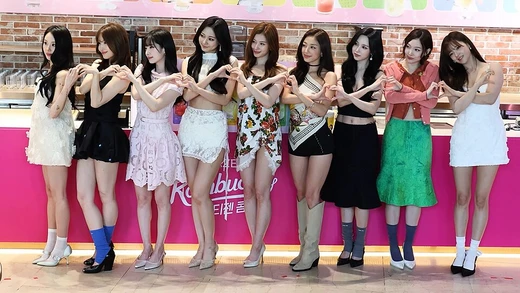
TWICE
Nine girls, one frequency: the sound of pure, unfiltered pop joy—like a sugar rush you never want to come down from.

TWICE is a nine-member South Korean girl group formed under JYP Entertainment and debuted in 2015. They occupy a singular space in the K-pop landscape: a group whose identity is built on unapologetic joy, bright color palettes, and earworm pop hooks that feel like sunshine pressed into a three-minute song. Rather than chasing a single dark concept or edgy image, TWICE has consistently leaned into a warm, approachable, high-energy persona that resonates across language barriers. Within the broader 'universe' of K-pop culture, TWICE functions as both a musical act and a cultural touchstone. Their fan community, ONCE, is one of the most recognizable in the genre, and the group's longevity—spanning nearly a decade of active output—has made them a reference point for how a pop group can evolve while keeping its core identity intact.
- Group type
- South Korean girl group
- Label
- JYP Entertainment
- Members
- 9 (Nayeon, Jeongyeon, Momo, Sana, Jihyo, Mina, Dahyun, Chaeyoung, Tzuyu)
- Debut year
- 2015
- Fanbase name
- ONCE
- Nationalities represented
- South Korean, Japanese
Lore & Background
TWICE's world is one of saturated pastels, synchronized choreography, and a vocal blend that shifts between bright belting and soft, breathy harmonies. The group's creative identity has always been anchored in the idea of 'twice-ness'—a playful, slightly mischievous energy that makes every performance feel like an invitation rather than a spectacle. Their songs tend to center on themes of youthful confidence, friendship, and the small electric moments of everyday life, rendered in production that favors immediate, singable melodies over complexity. What sets TWICE apart in the crowded K-pop ecosystem is their consistency of tone. Where many groups cycle through radically different concepts each release, TWICE has maintained a recognizable sonic and visual signature while still allowing individual members' personalities to surface. Jihyo's commanding stage presence, Momo's explosive dance lines, Sana's infectious smile, and Mina's ethereal vocal color all coexist without any single member dominating the narrative. The group's relationship with ONCE is often described as mutual: the fans amplify the group's joy, and the group's warmth makes the fanbase feel like a genuine community rather than a consumer base. This reciprocal energy has sustained TWICE through industry shifts, generational turnover, and the constant pressure of a hyper-competitive music market.
In Their Own Story
The backstage corridor smells like hairspray and cold coffee. Nine pairs of shoes—some studded, some soft-soled—tap a loose rhythm on the linoleum as the girls line up, checking each other's hair, fixing a stray feather on a headpiece. Jihyo runs through the last four counts under her breath, and the room goes quiet. Momo cracks her neck. Sana whispers something to Mina that makes both of them laugh, shoulders shaking, and the tension that's been building in the air since the soundcheck dissolves into a warm, shared exhale. Then the stage manager's voice crackles over the intercom: 'Thirty seconds.' The laughter stops. The smiles reset into something sharper, brighter, aimed at a camera that isn't there yet. They step into the light, and the world outside the stage door ceases to exist for exactly three minutes and forty-two seconds.
Reader's Guide
Name: TWICE (트와이스)
DID_YOU_KNOW: TWICE's fanbase name, ONCE, is a play on the group's name and implies a singular, unbreakable bond—'once you're in, you're in.' | The group includes members from both South Korea and Japan, making their in-group dynamics a genuine cross-cultural blend rather than a purely domestic formation. | Despite the K-pop industry's reputation for rapid concept cycling, TWICE has maintained a recognizable 'bright pop' identity for nearly a decade—an anomaly in a scene where groups often pivot to darker, more mature concepts to stay relevant. | Jihyo, the group's leader, is also a primary vocalist and choreography contributor, a role that has made her a vocal anchor for the group's more demanding tracks; she's known for belting live while executing complex formations, a feat that leaves even seasoned dancers winded.
Did You Know?
- TWICE's fanbase name, ONCE, is a play on the group's name and implies a singular, unbreakable bond—'once you're in, you're in.'
- The group includes members from both South Korea and Japan, making their in-group dynamics a genuine cross-cultural blend rather than a purely domestic formation.
- Despite the K-pop industry's reputation for rapid concept cycling, TWICE has maintained a recognizable 'bright pop' identity for nearly a decade, which is unusual for a group of their size and visibility.
- Jihyo, the group's leader, is also a primary vocalist and choreography contributor, a role that has made her a vocal anchor for the group's more demanding tracks.
Creative Reimagining and Production
The 1967 film marked a significant creative departure within the James Bond franchise. Rather than adapting Ian Fleming's 1964 novel in a straightforward manner, the production chose to use only a handful of characters and locations from the source material as a backdrop for an entirely new narrative. The screenplay was penned by Roald Dahl, lending the script a distinctive literary voice. Director Lewis Gilbert helmed the project, which became the first of three Bond films he would oversee for Eon Productions. This willingness to abandon most of Fleming's original plot structure signaled a new era for the series, one in which the franchise could evolve beyond its literary roots while still honoring the core identity of the character. The result was a film that felt both familiar and refreshingly reinvented, setting a precedent for future entries in the franchise to take greater creative liberties with their source material.
A Cold War Thriller Set Against the Cosmos
The narrative places the specter of nuclear annihilation at its center. When American and Soviet spacecraft are simultaneously hijacked from orbit, each superpower immediately blames the other, and global tensions spiral toward catastrophe. MI6 operative James Bond is dispatched to Japan to uncover the truth behind the disappearances. His investigation leads him from Tokyo's sumo tournaments to the docks of Kobe, where the cargo ship Ning-Po was delivering components for rocket fuel. The trail ultimately points to a secret base hidden inside a volcano on a remote island, operated by Ernst Stavro Blofeld and his SPECTRE organization. Blofeld has been hired by an unnamed Asian power, strongly implied to be China, to engineer a provocation that will trigger a full-scale war between the United States and the Soviet Union. The climax sees Bond infiltrating the SPECTRE spacecraft Bird One as it closes in on an American capsule, with nuclear forces poised to strike, before he triggers a self-destruct sequence and escapes as the volcanic base erupts beneath him.
Cast and the Unmasking of Blofeld
Sean Connery returns as the iconic MI6 agent, delivering a performance that anchors the film's globe-trotting espionage. Akiko Wakabayashi brings depth to Aki, a Japanese secret service operative who becomes Bond's crucial ally in Tokyo, while Tetsurō Tamba portrays Tiger Tanaka, the head of Japan's secret service, with his voice dubbed by Robert Rietty for English-speaking audiences. Perhaps the most consequential casting decision in the film's history is the choice to finally reveal the face of Ernst Stavro Blofeld. Although the SPECTRE villain had appeared in previous Bond entries, this was the first time audiences were shown his full visage, transforming him from a shadowy figure into a tangible, menacing presence. The film also introduces Helga Brandt, a SPECTRE agent whose betrayal of Bond aboard the Ning-Po and her eventual fate in a piranha-filled pool became one of the series' most memorable and darkly comic set pieces.
Box Office, Departure, and Legacy
Despite earning positive critical reception and generating over $111 million in worldwide box-office revenue, an amount equivalent to roughly $1.1 billion in 2025 dollars, the film marked the first time the Bond franchise experienced a dip in earnings. The decline was largely attributed to an oversaturation of the spy genre, as numerous imitators flooded the market, including a competing film also titled Casino Royale, produced by Columbia Pictures that same year. Compounding the franchise's transitional moment, it was announced during the Japan filming schedule that Sean Connery would step away from the role. He returned after a single absence in 1971's Diamonds Are Forever and later reprised the character in the 1983 non-Eon production Never Say Never Again. The series itself moved forward without him, with On Her Majesty's Secret Service (1969) becoming the first official Bond film to feature a different lead actor, ushering in a new chapter for the franchise.
Frequently Asked Questions
Who is TWICE?
TWICE is a nine-member South Korean girl group under JYP Entertainment that debuted in October 2015. The lineup—Nayeon, Jeongyeon, Momo, Sana, Jihyo, Mina, Dahyun, Chaeyoung, and Tzuyu—spans both South Korean and Japanese nationalities.
What role does TWICE play in K-pop culture?
TWICE carves out a distinctive niche as a group defined by bright, high-energy pop and an unapologetically joyful image rather than the darker concepts that often dominate the industry. They function simultaneously as a musical act and a cultural touchstone, crossing language barriers through catchy hooks and a warm, approachable persona.
How does TWICE's story end?
Because TWICE is a real-world act rather than a scripted narrative, there is no fixed ending to their story. Their ongoing trajectory is shaped by contract decisions, member choices, and the shifting K-pop landscape rather than a predetermined plot arc.
Why is TWICE important to K-pop?
TWICE demonstrated that a group could reach massive global heights by committing to sunshine-bright pop, vivid color palettes, and earworm melodies instead of chasing edgier aesthetics. Their consistent identity set a benchmark for how approachable, feel-good pop could compete at the industry's highest level.
What is the name of TWICE's fanbase?
The official fanbase name for TWICE is ONCE, a wordplay that mirrors the group's name while evoking a singular, unified community. Fans worldwide rally under this identity across concerts, social media, and collaborative fan projects.
More in Factions & Groups
Elsewhere in the Twice universe
Spotted an error? Know more?
This is a living reference — every entry is fact-audited, and reader corrections feed straight into our audit queue. Suggest an edit · See this site's audit record