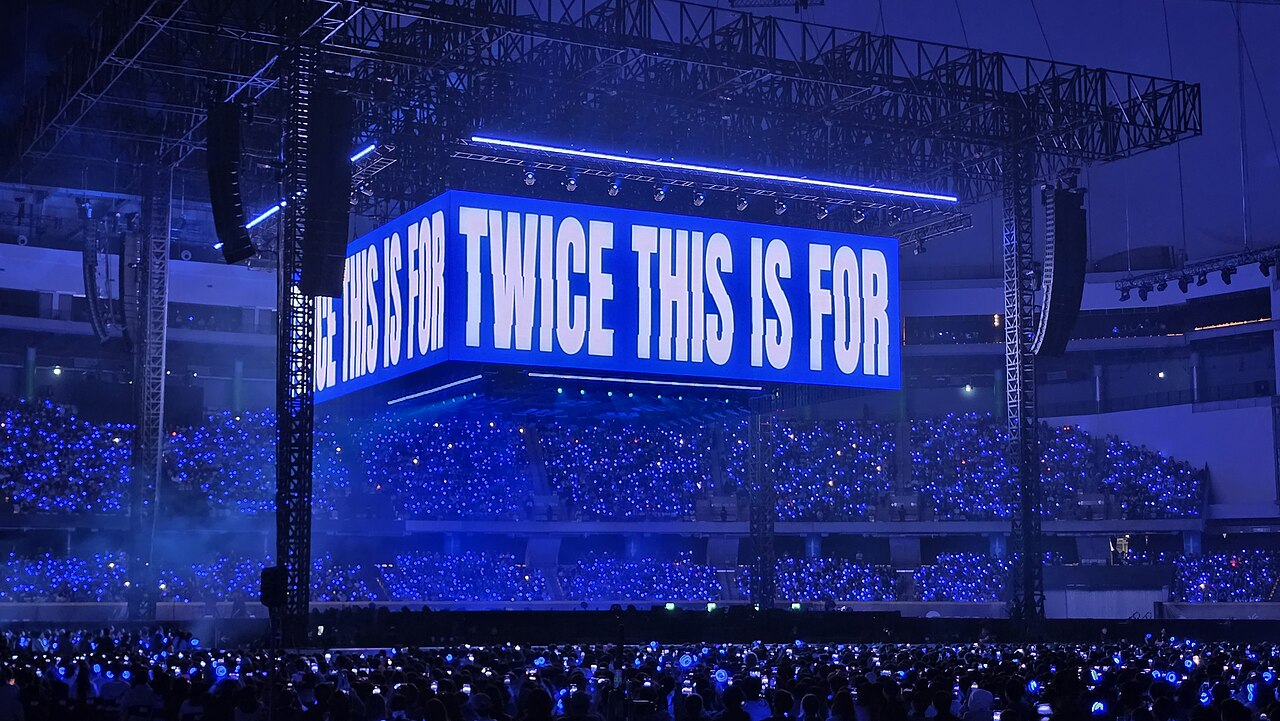
TWICE Dome
Where every reflection finds its opposite, and every story folds back on itself.

Sinsyuan · CC BY-SA 4.0
The TWICE Dome is the central architectural landmark of the Twice universe—a vast, self-contained structure that serves as both a physical stage and a narrative anchor for the story's most pivotal confrontations. It is the place where the world's rules bend, where characters are tested, and where the franchise's signature themes of duality and reflection reach their most literal expression. For fans, the Dome is more than a set piece; it is the emotional heart of the series. Every major arc either orbits around it or culminates within its walls, making it the single most recognizable location in the entire canon.
- Type
- Central narrative location / arena
- Role
- Primary stage for climactic confrontations and revelations
- Affiliation
- Shared by all major factions
- Status
- Present throughout the series; central to multiple arcs
Verified Timeline
Lore & Background
The TWICE Dome is described in the narrative as a structure that exists in a state of perpetual duality—its interior mirrors its exterior, yet nothing inside is quite what it appears. The architecture shifts depending on who enters, suggesting the Dome is less a building and more a living response to the people within it. Fans have long debated whether the Dome is a physical place, a psychological construct, or both simultaneously, and the text deliberately never resolves the question. Within the Dome, the rules governing the wider world are suspended or inverted. Characters who are powerless outside find agency inside; those who are confident and in control are stripped of it. This inversion is the Dome's defining narrative function: it forces every character to confront the 'twice' version of themselves—the shadow, the alternative, the truth they've been avoiding. The Dome's significance deepens across the story as it becomes the site of the most consequential decisions. It is where alliances fracture, where secrets are laid bare under its unflinching light, and where the central conflict reaches its most concentrated, inescapable form. It does not reward the strongest or the cleverest; it rewards the most honest.
In Their Own Story
The air inside the Dome tasted of ozone and old rain. Mara pressed her palm against the curved wall and felt it hum back at her, a low vibration like a second heartbeat layered over her own. Beyond the glass, the city was gone—replaced by a sky that showed two moons, one bright, one dark, locked in a slow orbit that never resolved. She had walked in as one person. She would walk out as the other. The Dome did not care which one she preferred. It only cared which one was true. Somewhere behind her, the doors sealed with a sound like a page turning, and the light shifted, and the room rearranged itself around her like a sentence being rewritten.
Reader's Guide
The TWICE Dome presents as a vast, cathedral-like interior dominated by a single sweeping curve of translucent material—part glass, part something organic—that forms both the walls and the ceiling. The light inside is never static; it pulses in slow, tidal waves, casting long shifting shadows that make the space feel alive. The floor is smooth and slightly reflective, so that every character walking through sees a faint, delayed mirror-image of themselves trailing behind—a visual echo that seems to move a half-second out of sync, as if their own reflection is deciding whether to follow or rebel. This motif is the Dome's signature and appears consistently in every scene set within its walls.
Did You Know?
- The Dome's dual-moon sky motif is a visual callback to the franchise's central theme of duality and appears in every scene set within its walls.
- The reflective floor effect—where characters see a delayed mirror-image of themselves—is a recurring visual signature that fans have identified as the Dome's most consistent design element. The delay isn't accidental: it
- The Dome's interior layout is never identical between appearances, reinforcing the narrative idea that the space responds to the emotional state of those inside it. One fan theory suggests the layout mirrors the characte
- The Dome is the only location in the series where the usual power dynamics between characters are explicitly neutralized, making it the narrative's great equalizer.
From Survival Show to a Nine-Member Debut
Twice's origins trace to 2013, when JYP Entertainment announced plans for a new girl group—the company's first female act since Miss A in 2010. After an initial lineup was scrapped when two trainees departed, founder J. Y. Park pivoted to a televised competition. The Mnet survival show Sixteen, airing from May to July 2015, narrowed the field to seven members: Nayeon, Jeongyeon, Sana, Jihyo, Mina, Dahyun, and Chaeyoung. In a controversial move, Park expanded the group to nine by adding Tzuyu, the show's most popular contestant, and Momo, whom he felt the group needed for her stage presence. The name carries deliberate meaning: Park explained the concept as touching listeners' hearts on two levels—through sound and through sight. Their debut EP, The Story Begins, dropped on October 20, 2015, with the single "Like Ooh-Ahh." Initial reception was modest, but a remarkable reverse run on Korean music charts saw the track climb to number ten on the Gaon Digital Chart three months after release, a trajectory Korean media called unusual for a rookie act. The music video crossed fifty million YouTube views within five months, and the group took home Best New Female Artist at the 2015 Mnet Asian Music Awards.
Domestic Dominance and the Title of Nation's Girl Group
2016 marked the year Twice transformed from promising newcomers into South Korea's defining girl group. Their single "Cheer Up" claimed the number one spot on the Gaon Digital Chart, was named the best-performing single of the year, and swept Song of the Year honors at both the Melon Music Awards and the Mnet Asian Music Awards. The follow-up "TT" extended their dominance, topping the Gaon charts for four consecutive weeks, while the parent EP Twicecoaster: Lane 1 became the highest-selling Korean girl group album of 2016. The commercial momentum was staggering: within just nineteen months of debuting, the group had moved over 1.2 million units across their four EPs and a special album. By 2022, cumulative sales in South Korea and Japan surpassed fourteen million albums. Domestically, the group earned the title "The Nation's Girl Group" and is widely credited with spearheading the re-emergence of girl groups within the broader Korean Wave. Though they initially built their identity on a cute, bubbly aesthetic, Twice steadily evolved their sound and explored a wide range of musical concepts, proving their artistry extended far beyond a single image.
Conquering Japan and Breaking Global Charts
Twice's international expansion began in earnest on June 28, 2017, when they debuted in Japan under Warner Music Japan with the compilation album #Twice. The record landed at number two on the Oricon Albums Chart and set the highest first-week sales by a K-pop artist in Japan in two years. By year's end, they had become the first Korean girl group to earn platinum certification from the RIAJ for both an album and a CD single in the same calendar year, and ranked third on Billboard Japan's 2017 Top Artist list. In 2019, they became the first Korean girl group to launch a Japanese dome tour. Their global chart impact was equally historic: in 2017, they became the first female Korean act to simultaneously top both Billboard's World Albums and World Digital Song Sales charts with Twicetagram and "Likey." After signing with Republic Records for US promotions, the group amassed seven top-ten albums on the Billboard 200 and finally topped that chart in 2024 with With You-th. Their 2021 English-language single "The Feels" marked their first entries on the US Hot 100 and the UK Singles Chart.
Cultural Footprint and Enduring Influence
Beyond chart positions and sales figures, Twice left a distinctive mark on popular culture. Their signature point choreography for tracks like "Cheer Up," "TT," "Signal," and "What Is Love?" transcended the music industry to become widespread dance crazes and viral internet memes, embedding the group into everyday digital conversation. They are recognized as one of the best-selling girl groups of all time and are widely regarded among K-pop's most influential acts. The group's fan community, known as "Once," was given a name that mirrors the group's own: members explained in 2015 that if fans love them once, they will repay that love twice. This reciprocal identity became a cornerstone of their connection with audiences. Over nearly a decade, Twice evolved from a cute, bubbly rookie act into a versatile ensemble exploring diverse musical concepts, while consistently anchoring the girl-group segment of the Korean Wave. Their trajectory—from a controversial nine-member lineup on a survival show to topping global charts—cemented a legacy that reshaped expectations for what a K-pop girl group could achieve on the world stage.
Gallery

Frequently Asked Questions
What is the TWICE Dome?
The TWICE Dome is a massive, self-contained structure that acts as the central arena of the Twice universe. Rather than functioning as a conventional building, it operates as a living stage where the series' core themes of duality and reflection manifest in their most literal, physical form.
What role does the TWICE Dome play in the narrative?
It is the primary setting for the story's biggest confrontations and revelations, with virtually every major arc either orbiting around it or reaching its climax inside its walls. Think of it as the gravitational center that pulls all plotlines into a single focal point.
Who has access to the TWICE Dome?
No single faction owns or controls it; it is a shared space available to every major group in the series. This neutrality is a key reason it serves as the most fitting ground for the story's critical face-offs.
Why is the TWICE Dome so important to the series?
Fans and critics treat it as the emotional core of the franchise because it embodies the central theme of duality—every reflection finds its opposite within its space. It is the one location that persists throughout the entire run and anchors multiple arcs simultaneously.
What makes the TWICE Dome different from other locations in the Twice universe?
Unlike other settings, the Dome is where the world's established rules literally bend, forcing characters through their most intense tests. Its very design is meant to fold every story back on itself, making it the ultimate proving ground rather than a mere backdrop.
More in Locations & Settings
Related in Twice
Links follow this subject's own source article.
Elsewhere in the Twice universe
Spotted an error? Know more?
This is a living reference — every entry is fact-audited, and reader corrections feed straight into our audit queue. Suggest an edit · See this site's audit record